John Chapter 8: Mercy, Light, Freedom, and the Great “I Am”

John Chapter 8 is one of the most intense chapters in John’s Gospel.
Jesus shows mercy to a woman caught in adultery.
He declares Himself to be the light of the world.
He speaks of truth, slavery, and freedom.
He confronts people who claim Abraham but reject Abraham’s promised offspring.
And at the end of the chapter, He says:
“Before Abraham was, I am.”
That statement brings the conflict to a breaking point.
In John Ch7, Jesus exposed false judgment and called the thirsty to come to Him for living water. In John 8, the division becomes even sharper. The question is not only whether people admire Jesus, but whether they receive His word, His light, His mercy, and His divine identity.
The Woman Caught in Adultery
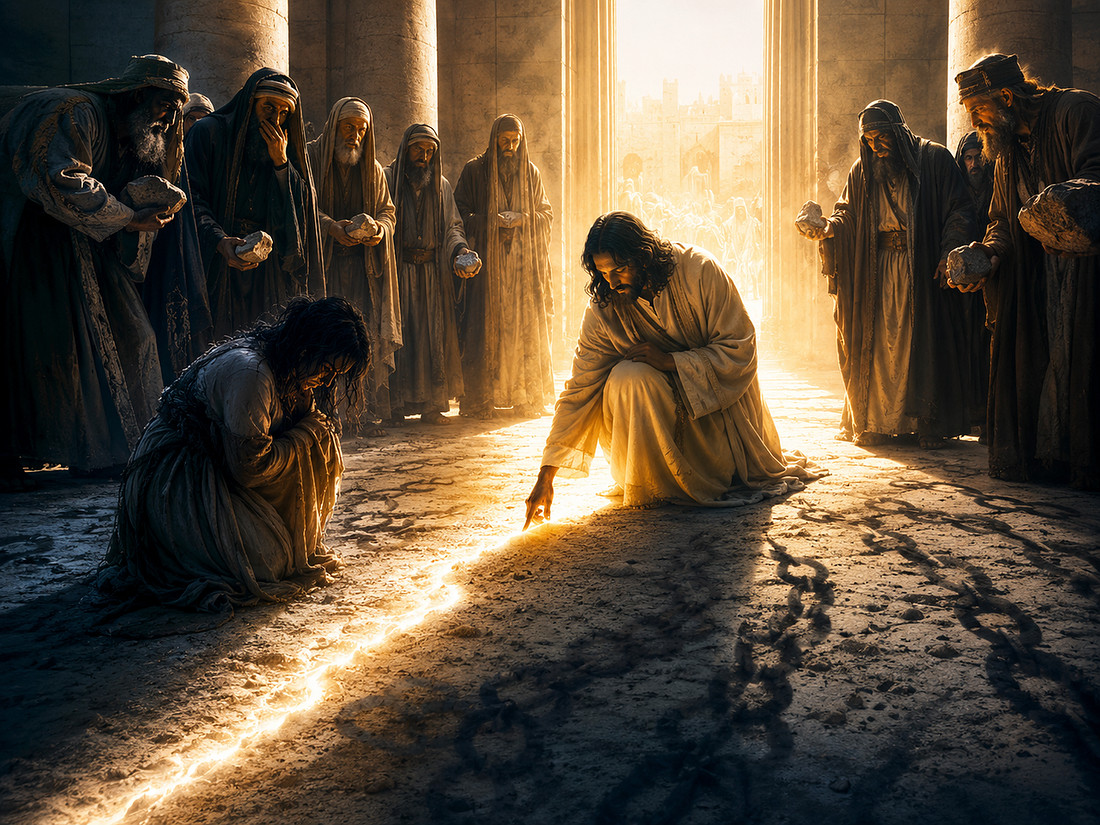
The chapter begins with the scribes and Pharisees bringing a woman caught in adultery.
They place her before Jesus and ask whether she should be stoned according to the Law of Moses.
John tells us they are testing Jesus.
That matters.
They are not mainly concerned with holiness, mercy, justice, or the woman’s restoration. They are trying to trap Jesus.
Jesus bends down and writes on the ground. The text does not tell us exactly what He wrote, so we should not pretend to know.
Then He says:
“Let him who is without sin among you be the first to throw a stone at her.”
One by one, they leave.
Jesus then asks the woman whether anyone has condemned her.
She says no one.
Then Jesus says:
“Neither do I condemn you; go, and from now on sin no more.”
This is mercy, but it is not soft approval of sin.
Jesus does not say adultery is harmless.
He does not say sin does not matter.
He says He does not condemn her, and then He calls her away from sin.
That is important.
The mercy of Christ does not leave sinners where they are.
It forgives.
It restores.
It calls to repentance.
From a Christian Reformed lens, this is grace. The sinner does not stand before Christ with excuses or achievements. The sinner needs mercy. But grace is never permission to keep sin as master.
Jesus saves sinners.
And the saved sinner is called to a new life.

I Am the Light of the World
Jesus then says:
“I am the light of the world.”
Whoever follows Him will not walk in darkness, but will have the light of life.
This connects strongly with John Ch1, where John says the light shines in the darkness, and the darkness has not overcome it.
Jesus is not merely one light among many.
He is the light of the world.
The Pharisees challenge His testimony. Jesus answers that even if He testifies about Himself, His testimony is true, because He knows where He came from and where He is going.
Then He says something that can sound confusing:
“I judge no one.”
But immediately He says that if He does judge, His judgment is true.
So what does He mean?
Jesus is not saying He has no authority to judge. John has already shown in John Ch5 that the Father has given judgment to the Son.
The point is that Jesus is not judging according to fallen human standards.
He does not judge by mere appearance, worldly opinion, or selfish motive.
His mission in His first coming is not to bring final condemnation immediately, but to reveal the Father, speak the truth, and save sinners.
Yet when He does judge, His judgment is valid because He is not alone. The Father who sent Him is with Him.
So Jesus is not denying His role as Judge.
He is showing the difference between human judgment and divine judgment.
Human judgment is often shallow, proud, and appearance-based.
Christ’s judgment is true because He comes from the Father and speaks in perfect unity with the Father.
This connects with John Ch7, where Jesus says not to judge by appearances, but with right judgment.
Where I Am Going, You Cannot Come
Jesus then tells them that He is going away, and they will seek Him, but they will die in their sin.
They ask if He is going to kill Himself.
They do not understand Him.
Jesus says:
“You are from below; I am from above. You are of this world; I am not of this world.”
This is not saying that earth is literally hell, or that there is no worse judgment than life in this world. Scripture clearly speaks of final judgment beyond this present life.
But Jesus is drawing a sharp spiritual contrast.
“Below” means the fallen order opposed to God.
“Of this world” means belonging to the unbelieving world system that resists the Father and rejects the Son.
Jesus does not belong to that order.
He is from above.
He is sent by the Father.
He comes into the world, but He is not from the world.
That should make us think seriously. The world can feel normal to us because we live in it. Its values, fears, ambitions, sins, and pride can seem natural. But Jesus says there is a deep difference between what is from below and what is from above.
From a Reformed lens, this reminds us that sinners do not merely need earthly improvement. We need rescue from the realm of darkness. We need the Son from above.
Jesus says unless they believe that He is, they will die in their sins.
That is the issue.
Not merely morality.
Not merely religious identity.
Faith in Christ.
The Truth Will Set You Free
Jesus then says that if they abide in His word, they are truly His disciples. They will know the truth, and the truth will set them free.
The people answer that they are offspring of Abraham and have never been enslaved to anyone.
That response is strange, because Israel’s history included slavery in Egypt, exile, and foreign domination. But more importantly, Jesus is speaking about a deeper slavery.
He says:
“Everyone who practices sin is a slave to sin.”
That is a strong statement.
Sin is not merely a mistake.
Sin is a master.
People often think freedom means doing whatever they want. But Jesus says a person can be doing what he wants and still be enslaved, because the heart itself is bound by sin.
The Son must set us free.
This connects with John Ch6, where Jesus calls people to receive Him Himself, not merely His gifts. True freedom is not keeping the old life untouched while adding Jesus to it. True freedom is being set free by the Son.
From a Christian Reformed lens, this is important. We are not born spiritually neutral. We need grace. We need liberation. We need the Son to free us from sin’s guilt, power, and final condemnation.
Abraham’s Children and the Devil’s Children
Jesus then confronts their claim to Abraham.
They say Abraham is their father.
Jesus answers that if they were truly Abraham’s children, they would do what Abraham did.
Abraham believed God.
Abraham rejoiced in God’s promise.
Abraham looked forward to Christ’s day.
But these people are trying to kill Jesus.
Their physical descent from Abraham does not mean they share Abraham’s faith.
That is the main issue.
Religious heritage is a gift, but it does not save apart from Christ.
Jesus then says something even stronger: they are acting like children of the devil because they oppose the truth and desire murder.
This is not gentle language.
Jesus is exposing the spiritual reality beneath their religious confidence.
They claim God as Father, but they reject the Son whom the Father sent.
That cannot stand.
A person cannot truly love the Father while rejecting the Son.
“You Are a Samaritan and Have a Demon”
Then the Jews answer Jesus:
“Are we not right in saying that you are a Samaritan and have a demon?”
This is an insult.
Calling Him a Samaritan was likely meant to accuse Him of being religiously compromised, outside the true people of God, or spiritually suspect.
Saying He has a demon is even more serious.
They are not merely disagreeing with Jesus.
They are attributing His words and ministry to evil.
This does remind us of the warning in Mark Ch3, where the scribes accuse Jesus of working by demonic power. That was a fearful accusation because they were calling the work of the Holy Spirit satanic.
Does John 8 mean these people have definitely committed the unforgivable sin?
The text does not say that directly.
So we should be careful.
But their accusation moves in that same dangerous direction. They are looking at the Son of God, hearing the truth of God, and saying He is demon-possessed. That is not ordinary confusion. It is deep spiritual hardness.
From a Reformed lens, we can say this: if a person truly repents and comes to Christ, he will be forgiven. But hardened, settled rejection of Christ while calling His truth evil is deadly. The danger is not that someone is too sinful for Christ to save. The danger is refusing the only Savior and calling light darkness.
Jesus responds calmly:
“I do not have a demon, but I honor my Father, and you dishonor me.”
He does not answer insult with panic.
He continues to honor the Father.
Before Abraham Was, I Am
The chapter reaches its height when Jesus says Abraham rejoiced that he would see His day.
The people are confused. Jesus is not yet fifty years old, and Abraham lived long before.
Then Jesus says:
“Before Abraham was, I am.”
This is one of the clearest statements of Jesus’ divine identity in John’s Gospel.
He does not merely say, “Before Abraham was, I existed.”
He says, “I am.”
This echoes the divine name and the language of God’s self-revelation. The people understand the seriousness of the claim because they pick up stones to throw at Him.
Jesus is not merely claiming to be older than Abraham.
He is claiming divine identity.
This connects with John Ch1, where John says the Word was with God and the Word was God.
The One speaking in John 8 is the eternal Son.
Abraham looked forward to Him.
Moses wrote of Him.
The Scriptures point to Him.
And yet many who claimed Abraham and Moses rejected Him.
That is the tragedy of the chapter.
The Message of John Chapter 8
John Chapter 8 shows mercy and judgment, light and darkness, slavery and freedom, Abraham and Christ.
Jesus shows mercy to the woman caught in adultery, but He also calls her to sin no more.
He says He is the light of the world.
He says His judgment is true because He is sent by the Father.
He says those from below need the One from above.
He teaches that sin is slavery.
He says the Son must set us free.
He exposes false confidence in religious heritage.
He is accused of being demon-possessed.
And He declares:
“Before Abraham was, I am.”
From a Christian Reformed lens, John 8 presses us to see that outward religion cannot save.
Being near Scripture is not enough.
Claiming Abraham is not enough.
Moral confidence is not enough.
Only Christ saves.
The woman caught in adultery needed mercy.
The religious leaders needed mercy too, but many did not see it.
That is the warning.
The obvious sinner may come trembling and find grace.
The religiously confident sinner may stand near the Light and still hate it.
But Christ remains the Light.
He is the Truth.
He is the Son who sets slaves free.
And whoever belongs to Him will not walk in darkness, but will have the light of life.