John Chapter 5: The Son Gives Life and the Scriptures Bear Witness

John Chapter 5 begins with a healing.
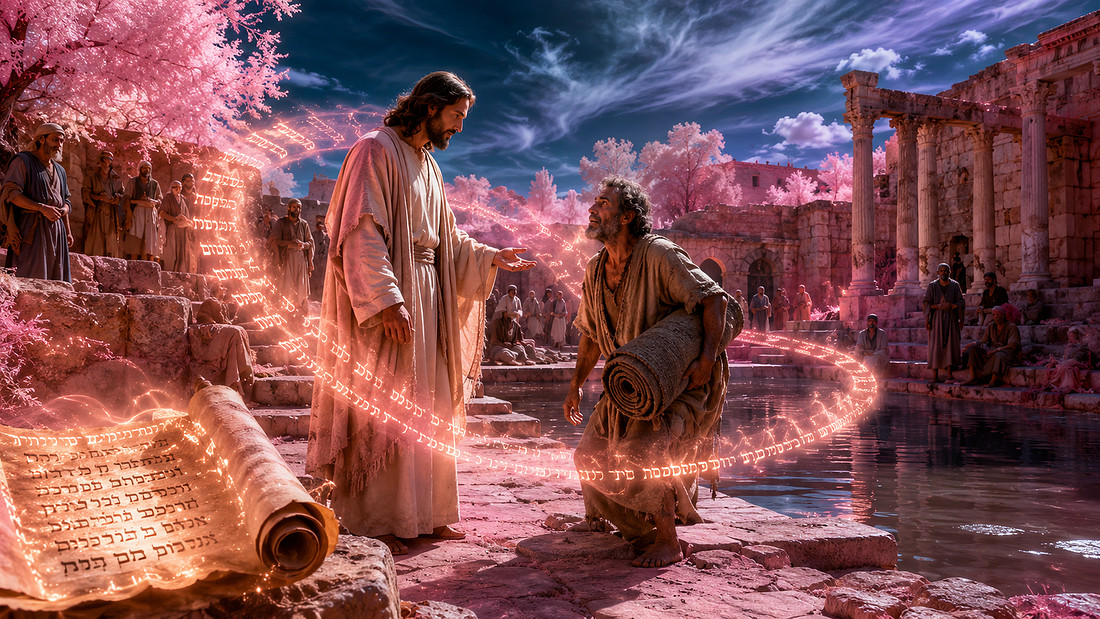
Jesus comes to Jerusalem and sees a man who had been an invalid for thirty-eight years. The man is lying near the pool of Bethesda, where many sick and disabled people gathered.
Jesus asks him:
“Do you want to be healed?”
The man explains his helplessness. He has no one to put him into the pool when the water is stirred.
Then Jesus says:
“Get up, take up your bed, and walk.”
Immediately the man is healed.
This is not a long process. Jesus does not need help from the pool. He does not need a ritual. He speaks, and the man walks.
This continues what John has already shown. In John Chapter 4: Living Water and the Savior of the World, Jesus gives living water and heals the official’s son by His word. Now in John 5, He heals a man who cannot heal himself.
The point is not only that Jesus is compassionate.
The point is that Jesus has divine authority.
The Sabbath Controversy
The healing happens on the Sabbath.
The Jewish leaders object because the healed man is carrying his bed. Instead of rejoicing that a man crippled for thirty-eight years has been made well, they focus on their Sabbath accusation.
Jesus answers:
“My Father is working until now, and I am working.”
That statement makes the conflict deeper.
Jesus is not merely saying, “I did a good thing on the Sabbath.” He is speaking of His unique relationship with the Father. John tells us that the Jewish leaders understood this as Jesus making Himself equal with God.
This connects with John Chapter 1: The Eternal Word and the Light of the World. The Son is not a mere prophet. He is the eternal Word who was with God and was God.
So John 5 is not just about Sabbath rules.
It is about who Jesus is.

The Son Does What the Father Does
Jesus says the Son can do nothing of His own accord, but only what He sees the Father doing.
That does not mean Jesus is weak or ignorant. It means the Son is perfectly united with the Father. The Father and Son do not work against each other. The Son does the works of the Father.
Jesus then says the Father raises the dead and gives life, and so the Son gives life to whom He will.
That is an enormous claim.
Only God gives life.
Only God raises the dead.
Only God has final authority over judgment.
Yet Jesus says the Father has given judgment to the Son, so that all may honor the Son just as they honor the Father.
That means refusing to honor the Son is refusing to honor the Father.
This is important because many people try to speak positively about God while rejecting Jesus. John 5 does not allow that. The Father is known through the Son. To reject the Son is to reject the One who sent Him.
Passing from Death to Life
Jesus says:
“Whoever hears my word and believes him who sent me has eternal life.”
He does not say such a person might have eternal life someday if he becomes impressive enough.
He says he has eternal life.
He has passed from death to life.
From a Christian Reformed lens, this is grace. Spiritually dead sinners do not raise themselves. The Son gives life. The Word of Christ is powerful. Those who believe have already passed from death into life.
This connects closely with John Chapter 3: Born Again by the Spirit and Loved by God, where Jesus teaches Nicodemus that a person must be born again by the Spirit. John 5 shows the same truth from another angle: the dead hear the voice of the Son of God, and those who hear will live.
Salvation is not self-improvement.
It is resurrection.
The Hour Is Coming, and Now Is Here
Jesus says an hour is coming, and now is here, when the dead will hear the voice of the Son of God, and those who hear will live.
There is likely a present and future meaning here.
Spiritually, the dead hear Christ’s voice now and live. Sinners are brought from spiritual death into eternal life.
But Jesus also speaks of a future resurrection, when all who are in the tombs will hear His voice and come out.
Some will rise to the resurrection of life.
Others will rise to the resurrection of judgment.
This is sobering.
Jesus is not merely a teacher offering advice. He is the Son of God whose voice gives life and whose authority extends to the final resurrection and judgment.
“If I Testify on My Own Behalf”
In the witness section, Jesus says:
“If I alone bear witness about myself, my testimony is not true.”
This can sound confusing.
Jesus is not saying, “If I say something about Myself, it is false.” Jesus never lies.
He is speaking in a legal or public-witness sense. In biblical law, a matter was established by more than one witness. Jesus is saying that He is not asking them to accept a merely unsupported self-claim by normal human standards.
There is testimony beyond His own words.
There are witnesses to who He is.
“There Is Another Who Testifies”
Jesus says:
“There is another who bears witness about me, and I know that the testimony that he bears about me is true.”
This “another” points especially to the Father, though Jesus also goes on to mention several witnesses.
John the Baptist bore witness to Jesus.
Jesus’ works bear witness to Him.
The Father bears witness to Him.
The Scriptures bear witness to Him.
So Jesus is not standing alone as a man making an unverifiable claim. The Father has testified to the Son through John’s witness, through the works Jesus does, and through the Scriptures.
This connects with John Chapter 1, where John the Baptist is introduced as a witness. John was not the light, but he came to bear witness to the light.
Now in John 5, Jesus says John’s witness was real, but even greater testimony comes from the Father and the works the Father gave Him to accomplish.
“I Do Not Receive Glory from People”
Jesus then says:
“I do not receive glory from people.”
This does not mean Jesus refuses all proper honor from human beings. Jesus is worthy of worship, honor, faith, and obedience.
The point is that Jesus does not depend on human praise.
He is not like a religious leader trying to build a reputation. He does not need approval from the crowd to make His identity true. His glory comes from the Father, not from human applause.
That matters because He then says:
“But I know that you do not have the love of God within you.”
The problem with the leaders is not lack of religious activity. They study Scripture. They care about status. They receive glory from one another.
But they do not love God.
That is terrifying.
A person can be religious, respected, and biblically informed, yet still reject the Son of God.
Jesus exposes their heart. They love human praise more than the glory that comes from God.
Searching the Scriptures but Missing Christ
Jesus says:
“You search the Scriptures because you think that in them you have eternal life; and it is they that bear witness about me.”
The problem is not that they search the Scriptures.
Searching the Scriptures is good.
The problem is that they search the Scriptures while refusing the One to whom the Scriptures point.
They treat the Bible as if eternal life could be found apart from Christ. But the Scriptures bear witness to Jesus.
The Old Testament is not disconnected from Christ. Its promises, patterns, sacrifices, priesthood, temple, kingship, prophecy, and covenant hope all point forward to Him.
This connects with John Chapter 2: The First Sign and the True Temple, where Jesus identifies His body as the true temple. The temple itself pointed beyond itself to Christ.
So the issue is not Scripture versus Jesus.
The issue is whether we read Scripture rightly, with Christ at the center.
Moses Will Accuse You
Jesus says:
“Do not think that I will accuse you to the Father. There is one who accuses you: Moses, on whom you have set your hope.”
This is a strong statement.
The Jewish leaders claimed to honor Moses. They claimed to stand on the Law. But Jesus says Moses himself will accuse them.
Why?
Because Moses wrote about Christ.
If they truly believed Moses, they would believe Jesus.
This does not mean Moses wrote the name “Jesus of Nazareth” in every verse. It means Moses’ writings point forward to the Messiah.
The promise of the offspring of the woman in Genesis, the promise to Abraham, the Passover lamb, the sacrificial system, the priesthood, the tabernacle, the bronze serpent, and the prophet like Moses all point beyond themselves.
Moses’ writings prepare for Christ.
So when the leaders reject Jesus, they are not actually honoring Moses. They are rejecting the fulfillment of what Moses wrote.
The very Scriptures they claim as their defense become their accuser.
“If You Do Not Believe His Writings”
Jesus says:
“If you believed Moses, you would believe me; for he wrote of me. But if you do not believe his writings, how will you believe my words?”
This means that unbelief toward Jesus exposes unbelief toward the Scriptures.
They may claim to believe Moses, but they do not receive the meaning of Moses. They read the words, but they miss the Christ to whom the words point.
This is a warning for us too.
It is possible to handle the Bible externally while resisting its central message.
The Bible is not given so that we can admire ourselves for knowing religious facts. The Bible is given to lead us to Christ.
From a Reformed perspective, Scripture is the Word of God, and Christ is the center of Scripture. We do not honor the Bible less by seeing Christ in it. We honor the Bible rightly when we receive the Savior to whom it bears witness.
The Message of John Chapter 5
John Chapter 5 shows Jesus as the Son who gives life, judges the world, fulfills Scripture, and stands in perfect unity with the Father.
He heals the helpless man.
He works as the Father works.
He gives life to the dead.
He has authority to judge.
He is witnessed by John the Baptist, by His works, by the Father, and by the Scriptures.
He does not depend on human praise.
He exposes religious unbelief.
He shows that Moses himself points to Him.
The tragedy of John 5 is that the leaders search the Scriptures but refuse to come to Jesus for life.
That is the great issue.
Not merely whether someone is religious.
Not merely whether someone knows Bible facts.
Not merely whether someone respects Moses.
The question is:
Will we come to Christ?
Jesus says:
“You refuse to come to me that you may have life.”
That is the heart of the warning.
Life is not found in religious pride.
Life is not found in human praise.
Life is not found in Scripture treated apart from Christ.
Life is found in the Son.
He speaks, and the dead live.
He commands, and the helpless rise.
He fulfills what Moses wrote.
He reveals the Father.
And whoever hears His word and believes has passed from death to life.