Mark Chapter 5: Christ Over Demons, Disease, and Death

Mark Chapter 5 shows the authority of Jesus in three powerful scenes.
First, Jesus delivers a man possessed by many demons.
Then He heals a woman who had suffered from a flow of blood for twelve years.
Finally, He raises Jairus’s daughter from death.
The chapter follows naturally after Mark Chapter 4: Hearing the Word and Trusting the Lord of the Storm. At the end of Mark 4, Jesus commands the wind and sea, and they obey Him. Now in Mark 5, demons, disease, and death must answer to Him too.
Mark is showing us that Jesus is not merely a teacher.
He is Lord.
The Demon-Possessed Man
Jesus and His disciples come to the other side of the sea, to the country of the Gerasenes.
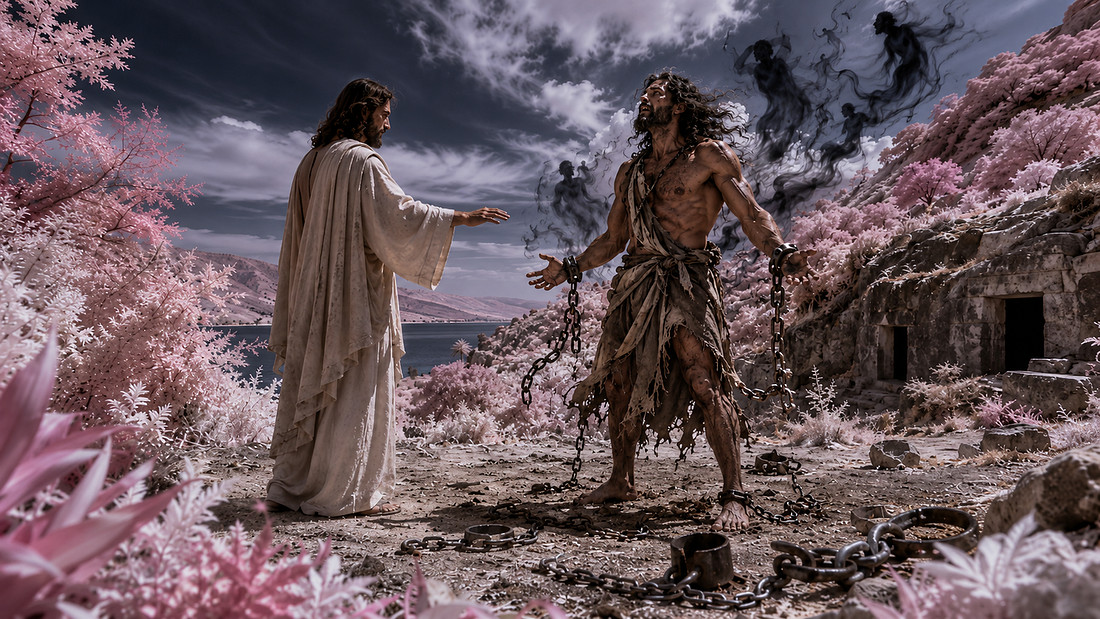
Immediately, a man with an unclean spirit comes out from the tombs.
Mark describes his misery in detail. He lived among the tombs. No one could bind him anymore, not even with a chain. He had often been bound with shackles and chains, but he broke them. Night and day among the tombs and mountains, he cried out and cut himself with stones.
This is a picture of terrible bondage.
The man is strong in one sense, but he is not free.
Sin and demonic power can look powerful, but they destroy. This man is isolated, tormented, unclean, and living among the dead.
This connects with Mark Chapter 3: Blasphemy Against the Holy Spirit and the Mercy of Christ, where Jesus describes Himself as the stronger One who binds the strong man. Satan is strong, but Christ is stronger.

“What Have You to Do with Me?”
When the man sees Jesus, he runs and falls down before Him.
Then he cries out:
“What have you to do with me, Jesus, Son of the Most High God? I adjure you by God, do not torment me.”
This is not worship in the saving sense.
The demon knows who Jesus is. He knows Jesus is the Son of the Most High God. But demons can know true facts and still hate God. Their knowledge is not faith. It is terror.
The phrase “What have you to do with me?” means something like, “What business do you have with me?” or “Why are you interfering with me?”
The demon knows Jesus has authority over him.
Then he says, “I adjure you by God, do not torment me.”
That is strange because the demon is trying to use solemn religious language toward Jesus. He is begging Jesus not to send him into torment. The demon knows judgment is coming. He knows Jesus has the authority to command him.
This is similar to what we saw in Mark Chapter 1: The Beginning of the Gospel of Jesus Christ, where an unclean spirit says, “I know who you are—the Holy One of God.” Demons recognize Jesus, but Jesus does not receive their testimony as faithful witness.
Legion
Jesus asks:
“What is your name?”
The answer is:
“My name is Legion, for we are many.”
A Roman legion was a large military unit. So the name “Legion” communicates multitude, strength, and occupation. This man is not afflicted by one demon only. Many demons are oppressing him.
When Jesus casts them out, yes, they come out of the same man.
That makes the deliverance even more astonishing. No human being could control this man. Chains could not hold him. But Jesus speaks, and the whole legion of demons must obey.
The demons beg not to be sent out of the country. Then they beg to be sent into a herd of pigs.
Jesus gives them permission.
The demons enter the pigs, and the herd rushes down the steep bank into the sea and drowns.
This is disturbing, but it shows several things.
First, demons are destructive. They destroy what they inhabit.
Second, Jesus has total authority over them. They cannot even enter the pigs without His permission.
Third, the deliverance of the man is worth more than the herd. The townspeople seem more troubled by the economic loss than amazed by the mercy shown to the man.
Why the People Wanted Jesus to Leave
Those who had seen what happened tell the people about the demon-possessed man and the pigs.
Then the people come and see the man sitting there, clothed and in his right mind.
That is a beautiful phrase.
The man who had lived naked, violent, isolated, and tormented is now sitting, clothed, and sane.
But instead of rejoicing, the people are afraid.
Then they beg Jesus to leave their region.
It seems likely that the loss of the pigs was part of their fear and frustration. A large herd had been destroyed. But there is more than money here. Jesus’ power is too much for them. His presence is disruptive. He has shown authority over the spiritual realm, and they do not want Him near.
That is sobering.
Sometimes people would rather keep a familiar broken world than have Christ overturn it.
They saw a man restored, but they also saw their economy shaken.
And they wanted Jesus to leave.
“Go Home to Your Friends”
The healed man wants to go with Jesus.
That makes sense. Jesus had rescued him. Why would he want to stay behind?
But Jesus tells him:
“Go home to your friends and tell them how much the Lord has done for you, and how he has had mercy on you.”
This is important.
In other places, Jesus tells people not to spread the news widely. But here He tells this man to go and tell.
The man goes away and begins to proclaim in the Decapolis how much Jesus had done for him.
Notice the connection:
Jesus says, “Tell them how much the Lord has done for you.”
The man proclaims how much Jesus had done for him.
Mark is showing us something about Jesus’ divine authority. What the Lord has done, Jesus has done.
The man becomes a witness, not because he has formal training, but because he has received mercy.
That is often where testimony begins.
Not with knowing everything.
But with saying, “This is what the Lord has done for me.”
Jairus and the Woman with the Hemorrhage
Mark then moves to another scene.
A synagogue ruler named Jairus comes to Jesus. His little daughter is near death. He falls at Jesus’ feet and begs Him to come and lay hands on her so she may be made well and live.
Jesus goes with him.
On the way, a large crowd presses around Jesus. In that crowd is a woman who had suffered from a discharge of blood for twelve years.
She had suffered much under many physicians. She had spent all she had. She was no better, but rather grew worse.
This woman is desperate.
She believes that if she touches even Jesus’ garments, she will be made well.
She comes behind Him in the crowd and touches His garment.
Immediately, the flow of blood dries up, and she feels in her body that she is healed.
Jesus asks:
“Who touched my garments?”
The disciples are confused because the crowd is pressing around Him. Many people are touching Jesus physically. But this woman touched Him in faith.
Jesus does not let her disappear anonymously.
He draws her out, not to shame her, but to restore her publicly.
She comes in fear and trembling and tells Him the whole truth.
Then Jesus says:
“Daughter, your faith has made you well; go in peace, and be healed of your disease.”
That word “daughter” is tender.
She had suffered for twelve years. She had likely lived with uncleanness, shame, isolation, and disappointment. Jesus not only heals her body. He speaks peace over her.
This connects with John Chapter 5: The Son Gives Life and the Scriptures Bear Witness, where Jesus heals the man at Bethesda who had been helpless for thirty-eight years. In both places, Jesus comes to people who cannot rescue themselves.
Did Her Faith Save Her?
Jesus says her faith has made her well.
That does not mean faith is a magical force by itself.
Faith receives Christ.
The power is not in the woman’s hand. The power is not in the fabric of the garment as an object. The power is in Jesus.
But faith matters because she comes to Him trusting that He can heal.
From a Christian Reformed lens, faith is the empty hand that receives Christ. Faith does not create the Savior’s power. Faith receives the Savior Himself.
Jairus’s Daughter Dies
While Jesus is still speaking, people come from Jairus’s house and say:
“Your daughter is dead. Why trouble the Teacher any further?”
That sounds final.
But Jesus says to Jairus:
“Do not fear, only believe.”
Then Jesus allows no one to follow Him except Peter, James, and John.
These three go with Jesus into the more private area of the house. They are often present at major moments in Jesus’ ministry. They are not better men by nature, but Jesus gives them a particular role as witnesses.
So yes, this becomes a restricted scene. The large crowd does not go in. Jesus takes the parents and these three disciples into the place where the child is.
Was the Child Dead or Only Asleep?
When Jesus comes to the house, there is commotion, weeping, and loud mourning.
He says:
“Why are you making a commotion and weeping? The child is not dead but sleeping.”
The people laugh at Him.
So was the girl actually dead, or just in a deep sleep?
The passage presents her as truly dead.
The messengers say she is dead. The mourners are already gathered. The people laugh at Jesus because they know she is dead. Jesus’ words do not mean, “You made a medical mistake; she is only sleeping.”
Rather, Jesus is speaking from His authority over death.
For us, death looks final.
For Jesus, death is like sleep from which He can wake someone.
This is not described as a demonic situation. Mark does not say a demon caused her death. This is different from the demon-possessed man earlier in the chapter. Here Jesus is confronting death itself.
He takes the child by the hand and says:
“Talitha cumi.”
Mark translates it:
“Little girl, I say to you, arise.”
Immediately the girl gets up and begins walking.
She was twelve years old.
Jesus tells them to give her something to eat.
That small detail matters. She is truly alive. This is not a vision. This is not symbolic only. The girl who was dead now walks and eats.
Why Mark Places These Stories Together
The woman had suffered for twelve years.
The girl was twelve years old.
One woman has endured twelve years of living death.
One girl has lived twelve years and then dies.
Jesus is Lord over both.
He heals chronic suffering.
He raises the dead.
He restores the unclean.
He speaks peace to the trembling.
He gives life to the lifeless.
Mark places the stories together so we see Jesus’ authority over every kind of human helplessness.
The demon-possessed man could not free himself.
The bleeding woman could not heal herself.
Jairus could not save his daughter.
But Jesus can.
The Message of Mark Chapter 5
Mark Chapter 5 shows Christ’s authority over demons, disease, and death.
The demons called Legion are many, but they cannot resist Jesus.
The pigs rush into the sea, showing the destructive nature of demonic power.
The townspeople see a man restored, but they ask Jesus to leave.
The healed man becomes a witness to the mercy of the Lord.
The bleeding woman touches Jesus in faith and is healed.
Jairus is told not to fear, but believe.
Peter, James, and John enter the house as witnesses.
The child is truly dead, but Jesus speaks to her as one waking from sleep.
She rises.
From a Christian Reformed lens, this chapter is not mainly about the strength of human faith. It is about the strength of Christ.
Faith matters because faith receives Christ.
But Christ is the Savior.
Christ is the Deliverer.
Christ is the Healer.
Christ is the Lord over death.
The man among the tombs becomes a messenger of mercy.
The unclean woman is called daughter.
The dead child is raised by the voice of Jesus.
That is the heart of Mark Chapter 5.
No chain can bind what Christ sets free.
No uncleanness is too deep for His mercy.
No death is too final for His voice.