John Chapter 6: The Bread of Life and the Words of Eternal Life

John Chapter 6 is centered on a major question: why are people coming to Jesus?
Some come because they want bread. Some come because they saw signs. Some come because they are curious. Some follow for a time, but turn away when His teaching becomes hard. But Peter sees the heart of the matter: Jesus alone has the words of eternal life.
Jesus Feeds the Five Thousand
John Chapter 6 begins with a crowd following Jesus because they had seen His signs. Jesus goes up on a mountain with His disciples, sees the crowd coming, and asks Philip where they can buy bread for the people. John tells us Jesus asked this to test Philip, because Jesus already knew what He would do.
The need was real. The crowd was hungry. The disciples did not have enough. But Jesus was not anxious or uncertain. This connects with Matthew Ch6, where Jesus teaches that the Father knows what His children need. In John 6, the Son shows that same divine provision in action.
Andrew finds a boy with five barley loaves and two fish. It is clearly not enough. But Jesus gives thanks and feeds the crowd. Everyone eats as much as they want, and twelve baskets are left over.
The sign shows that Jesus provides abundantly, but the people misunderstand Him. They recognize something great has happened, and they connect Him with the promised prophet like Moses. That makes sense because Moses was associated with manna in the wilderness. But when they want to take Jesus by force and make Him king, Jesus withdraws.
This connects with Matthew Ch4, where Jesus refuses the shortcut to kingdom glory apart from the cross. In John 6, the crowd also wants a kind of king who fits their earthly expectations. Jesus is King, but He did not come merely to be a political bread-provider. He came to give something greater.
Jesus Walks on Water
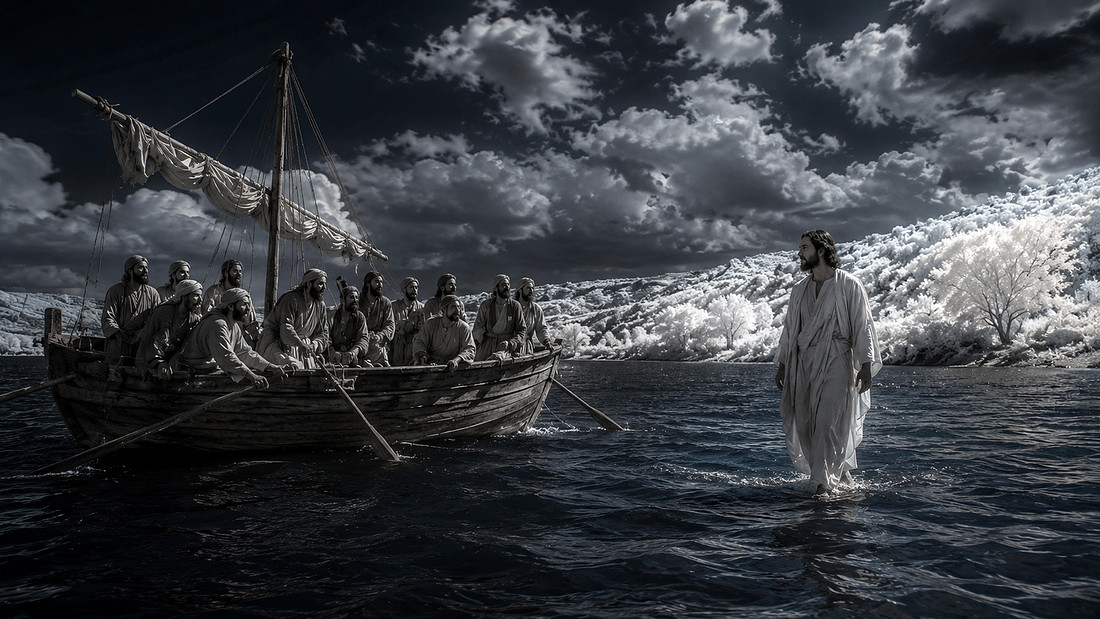
That night, the disciples cross the sea toward Capernaum, and the sea becomes rough. Then Jesus comes to them walking on the water, and they are afraid.
This is more than a display of power. In the Old Testament, the sea often represents danger, chaos, and forces beyond human control. Jesus walks over what terrifies them.
This connects with Mark Ch4, where Jesus calms the storm and the disciples ask who He is, that even the wind and sea obey Him. John gives the same answer: Jesus is Lord.
The One who feeds the hungry crowd also rules over the waters. He is not merely useful in calm moments. He is Lord in the storm.

I Am the Bread of Life
The next day, the crowd finds Jesus again. He tells them plainly that they are seeking Him because they ate their fill of the loaves. They saw the sign, but they are focused on the bread.
Jesus tells them not to labor merely for food that perishes, but for food that endures to eternal life. He is not saying physical needs do not matter. He had just fed them. But earthly bread cannot give eternal life.
This is similar to John Ch4. The Samaritan woman first thinks about ordinary water, while Jesus speaks of living water. In John 6, the crowd thinks about ordinary bread, while Jesus speaks of the bread of life.
Jesus then says that He Himself is the bread of life. That is the center of the chapter. He is not only the giver of bread. He is the bread. To come to Him is to believe in Him. To believe in Him is to receive Him by faith.
From a Christian Reformed lens, this is not human effort earning salvation. This is Christ offering Himself as the only food that gives eternal life. The sinner does not need to become impressive before coming. The hungry come to bread. The thirsty come to water. The dead need life.
This connects with John Ch5, where Jesus says the dead hear the voice of the Son of God and live. In John 6, that same life is described as eating the bread from heaven.
Jesus also says that no one can come to Him unless the Father draws him. This is one of the clearest statements of human inability and divine grace in John’s Gospel. People are responsible to come to Christ, but left to ourselves, we do not come. We need the Father to draw us.
This does not make faith unnecessary. It explains how faith happens. The Father draws sinners to the Son, and the Son promises that whoever comes to Him will never be cast out. That is strong comfort. Those given by the Father will come, and those who come will not be rejected. This fits with John Ch3, where Jesus teaches that new birth is the work of the Spirit.
Then Jesus speaks of eating His flesh and drinking His blood. This sounded shocking. He is not merely offering more bread. He is saying that eternal life comes through receiving Him Himself. His body would be given. His blood would be shed. He is the bread of life because He gives Himself for the life of the world.
It is not enough to admire Jesus, stand near Jesus, or want earthly help from Jesus. We must receive Jesus Himself.
The Words of Eternal Life
Many who hear Jesus say that this is a hard saying. The hard saying especially refers to His teaching about eating His flesh and drinking His blood. To many hearers, this sounded impossible to accept.
They wanted bread, signs, and excitement. But Jesus was telling them that they needed Him more than His gifts. They could not have eternal life through Moses, manna, religious heritage, miracles, or earthly bread. They needed the Son Himself.
This remains hard today, though perhaps in a different way. Many people are willing to admire Jesus, quote Jesus, appreciate His compassion, or want His help. But receiving Jesus means more than wanting comfort or inspiration. It means coming to Him as Lord and Savior.
It means we cannot cling to sin as if sin is still our master.
Jesus does not call sinners because they are already clean. He calls sinners to Himself so that they may have life. That life is not permission to remain unchanged. Christians still struggle, repent, and need grace every day, but we cannot receive Christ while insisting on keeping sin as king.
Jesus then says that the Spirit gives life and that the flesh is no help at all. He does not mean the human body is bad. He means fallen human ability cannot produce spiritual life. Human effort, wisdom, and religion cannot replace the work of the Spirit.
Many turn back and no longer walk with Him. That is sobering. People can follow Jesus for a time because of signs, crowds, bread, healing, curiosity, or excitement, but when His teaching confronts them, they may leave.
Jesus then asks the Twelve if they also want to go away. Peter answers that there is nowhere else to go, because Jesus has the words of eternal life.
Peter does not claim that everything is easy to understand. He does not say the teaching is light or simple. He knows that Christ alone has life. That is faith.
The chapter ends with Jesus saying that one of the Twelve is a devil. John tells us He was speaking about Judas.
That is a serious warning.
Judas heard the teaching.
Judas saw the miracles.
Judas walked with the Twelve.
He was outwardly close to Jesus, but his heart did not belong to Christ. He did not receive Jesus as the bread of life. Instead, he became aligned with betrayal and the devil’s work.
So the issue is not simply being near Christian things. Judas was very near. The issue is whether we truly receive Christ by faith.
A person can hear the words of Jesus and still resist Him.
A person can see the works of Jesus and still reject Him.
A person can be around disciples and still not be one in heart.
Judas reminds us that outward nearness is not the same as inward faith.
Peter’s response is the right one:
“Lord, to whom shall we go?”
That is where John 6 presses us.
Will we turn back when Jesus’ words are hard?
Or will we say with Peter that Christ alone has the words of eternal life?
John Chapter 6 shows Jesus as the true bread from heaven. He feeds the crowd, walks on the sea, exposes shallow motives, teaches that no one comes unless the Father draws, promises not to cast out those who come, and speaks of giving His flesh for the life of the world.
From a Christian Reformed lens, this chapter shows both human responsibility and sovereign grace. We are called to come, believe, repent, and receive Christ. But the Father must draw, the Spirit must give life, and the Son must give Himself.
The crowd wanted bread for the stomach.
Jesus offered Himself as bread for eternal life.
Christ is not merely useful.
Christ is necessary.
He is not only the giver of gifts.
He is the gift.
He is the bread of life, and whoever comes to Him will never be cast out.