Russia’s Ambitions in Syria: Power, Propaganda, and the ‘Z’ Symbol

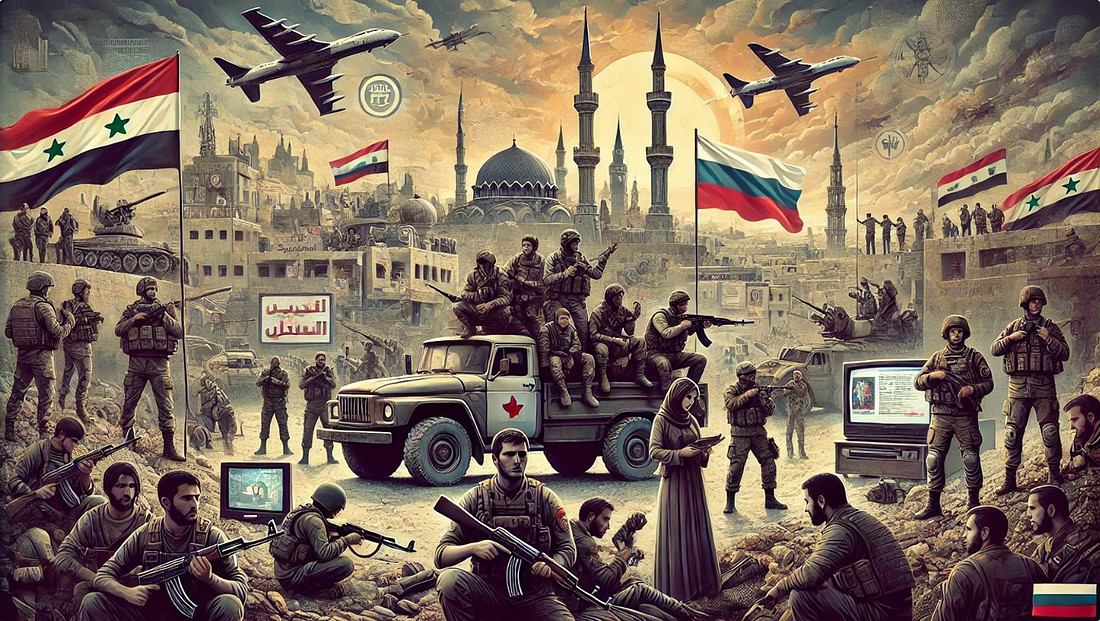

Russia’s long-standing presence in Syria, which began in earnest after its 2015 military intervention, has always served multiple strategic ends: securing influence in the Middle East, preserving its military foothold in the Eastern Mediterranean, propping up President Bashar al-Assad’s government, and crafting a narrative of renewed great-power status on the global stage. Almost a decade later, these goals remain essentially the same, but the means and messaging have evolved—especially given recent upheavals within Russia’s mercenary networks and the protracted war in Ukraine that continues to drain resources and shape the Kremlin’s priorities.
From Wagner to State-Controlled Contractors: A Shifting Landscape of Russian Influence
For several years, the Wagner Group played a pivotal role in securing Russian interests in Syria. This private military company, operating with the Kremlin’s tacit approval, carried out ground operations, secured energy assets, and extended Moscow’s reach beyond the capabilities—or deniability—of its regular forces. However, the Wagner Group’s attempted mutiny in June 2023, and the death of its leader Yevgeny Prigozhin shortly thereafter, led to a profound restructuring of Russia’s paramilitary ecosystem. By late 2024, Wagner’s operational independence in Syria is effectively over. Many of its fighters have been absorbed into Russia’s Defense Ministry structures or replaced by other Kremlin-vetted security contractors, ensuring tighter state control and more direct command chains.
This shift affects not only Russia’s tactical approach in Syria but also its strategic posture. Without the once-autonomous Wagner carving out semi-private spheres of influence, the Kremlin has reasserted itself as the unequivocal master of Russian-backed operations. This centralization may streamline decision-making but also ties Syria’s battlefield outcomes more directly to the Kremlin’s reputation—particularly at a time when Moscow is still heavily engaged in Ukraine. With fewer “buffers” between its policies and their execution, Russia now visibly owns the successes or failures of its Syrian strategy.
Assad’s Precarious Balancing Act
President Bashar al-Assad remains in power, but his position is arguably more precarious today than at many points since Russia’s initial intervention. The Syrian economy is in dire straits, plagued by currency collapse, rampant inflation, and inadequate reconstruction. International sanctions, plus the lingering aftershocks of the global slowdown, have made any meaningful economic recovery elusive. A population already exhausted by years of conflict and deprivation now grapples with deepening hardship, and sporadic protests have erupted even in Assad’s core constituencies.
Although Russia has spent nearly a decade propping up the Assad regime—ensuring it did not crumble under the weight of insurgency and international isolation—Moscow’s capacity and willingness to invest in Syria’s long-term stability have diminished. With its military and economic focus siphoned off to the Ukrainian front, Russia is less inclined to offer substantial economic lifelines or costly new offensives on Assad’s behalf. Instead, the Kremlin’s approach seems focused on maintaining the status quo: keeping Damascus stable enough to serve Russian interests (such as retaining access to the Tartus naval facility) but not committing major additional resources that might undermine Russia’s strategic priorities elsewhere.
Propaganda, Perception, and the “Z” Symbol
The war in Ukraine has profoundly shaped Russia’s global messaging and iconography. The stylized “Z,” once primarily a battlefield marking, has become an emblem of Russian ultra-patriotism—and in some cases, a symbol of propaganda-driven loyalty to the Kremlin’s narratives. While in 2022 and 2023 it was commonly associated with Russian operations in Ukraine, by 2024 the symbol—and the propaganda machinery around it—have evolved to signify Russia’s broader international posture. For Russian state media and pro-Kremlin social accounts, the “Z” can be invoked as shorthand for defiance against Western influence, solidarity with Russian-backed leaders like Assad, and the righteousness of Russian strategic aims abroad.
In Syria, where the local population has long been a target for both regime- and Russia-driven narratives, this symbol and related propaganda are woven into a broader communications campaign. Syrian state media regularly echo Russian claims that Moscow’s presence deters “foreign aggression” and offers stability in the face of “extremist threats.” Moscow, for its part, frames its actions in Syria as proof that Russia stands by its allies—even as it carefully avoids overextending itself. The “Z” now appears in some Syrian social media circles aligned with pro-Russian militias or messaging campaigns, lending a veneer of support to the notion that Syria and Russia are united in resisting external pressure.
Looking Ahead: A Measured Grip on Influence
By the close of 2024, Russia’s ambitions in Syria remain focused on consolidating its influence while minimizing its commitments. Having learned hard lessons from the Wagner fallout and wary of overstretch due to the Ukrainian war, the Kremlin’s policy in Syria is one of calculated maintenance rather than bold expansion. The Assad regime—dependent on Russian political, military, and strategic cover—accepts these limitations in the absence of alternative patrons.
As global attention remains riveted on the shifting frontlines in Ukraine, Russia’s Syrian project continues in a lower orbit. Yet, this quieter but persistent presence should not be underestimated: through a careful mix of military support, energy asset control, security partnerships, and narrative management, Moscow ensures that Damascus remains in its orbit. The meaning of the “Z” symbol, once localized to a single conflict, has thus metastasized into a broader emblem of Russian ambition—a subtle, steady reminder that the Kremlin still views Syria as a cornerstone of its influence in the Middle East, even as the costs, capabilities, and calculations continue to evolve.