Shark Repellent Responses Australia, Brazil, Canada, France & Reunion Island

Responses are organized by country (countries presented in alphabetical order) spanning five continents.
Australia – Brazil - Canada - France & Reunion Island - New Zealand - Scotland – South Africa – United State of America.
AUSTRALIA
Well done on getting the discussion going. I think we’ve taken a rather piecemeal approach to the testing of shark repellents and it’s hard for consumers to know what to believe. Being a scientist I naturally gravitate towards the need for robust, empirical, peer-reviewed testing of the various options. As was concluded from the shark summit in Sydney last week, the technology still has a long way to go. I’ve worn shark deterrent devices (’shark shields’) a lot while working on the east coast of Australia, but I only wore them because it was EH&S policy of my University - not because I trusted them. Funnily, we used to work a lot with State Government and their EH&S policy banned the use of shark shields because their shark scientists believed it actually increased your chances of being attacked! From my reading of the various scientific testing that has been done on shark shields and other similar deterrent devices, their effectiveness really context specific and depends on the motivational state of the sharks. For example, a sharks shield may be effective for a curious a great white that approaches a surfer with curiosity, but not for a great white that is charging from below in full attack mode.
Dr Peter I. Macreadie
Senior Lecturer | Australian Research Council DECRA Fellow
Plant Functional Biology and Climate Change Cluster - UTS; &
Centre for Integrative Ecology, School of Life and Environmental Sciences
Faculty of Science Engineering & Built Environment, Burwood, Deakin University
Response
The potential threat that sharks pose to ocean users has led to the adoption of a range of shark control programs around the world that often involve the removal of sharks to reduce risk. These programs are at odds with the important ecological role that large predatory sharks play in ocean ecosystems, as they do not discriminate by species or size, so they place increased pressure on non-target and potentially vulnerable species. The effects of removing sharks from our oceans, although complex and rather unpredictable, can be ecologically and economically damaging. There is, therefore, a clear need for alternative non-lethal shark mitigation solutions that will allow humans and sharks to safely co-exist.
Research has shown that certain low-voltage electric fields can be effective at deterring a range of shark species, but questions still remain about the effectiveness of this type of stimulus over a prolonged period. My own previous research has shown that shark embryos will habituate to electric fields resulting in a reduced response to the stimulus over time. Now, my current research is investigating this effect in a range of wild sharks, including white sharks, to see if they will also habituate to an electric stimulus, and if so, determine how their behaviour may change over time. Once this information is published, we will be in a better position to develop new effective electric deterrents, and also provide advice on how we can improve current technologies. However, it is important to remember that no deterrent is ever going to be 100% effective. We must always take precautions to reduce our own risk of injury, and although a deterrent may well be part of the solution, it is unlikely to be the whole solution.

Dr. Ryan M. Kempster
Shark Biologist & Founder of Support Our Shark
The UWA Neuroecology Group
School of Animal Biology
University of Western Australia
Response
As a professional surf photographer based in Margaret River Western Australia which over years has had a number of fatal shark attacks around the area and with all the over the top press it was certainly in the back of my mind when swimming out to sea on my own. The only time I have ever used a so called shark repellent is when I swim at a place called the “Right”, being the only one in the water a mile out to sea where we have seen a number of Great Whites and been bumped on the ski is the only time I have to overcome a mental hurdle, to be honest I don’t even think the shark shield would even work on a Great White (I wear it only for peace of mind), I rely more on the feel of the situation and then I make my decision to swim or not swim. I would love to see an amazing scientific study on everything to do with sharks; amazing creatures and I look forward to swimming with them in the future to gain more knowledge on the subject.
Russell Ord
Photographer
Response
I love the ocean. I grew up in the water on the West Coast of Australia (where shark attacks are not uncommon). Sure, there's always that slight fear about what I can't see, but in reality, I'm probably surfing with sharks every day I go out without even realising.
I think people get wound up in the hysteria and forget that we are humans entering their environment. I am by no means a shark expert. have opinions, but they're not educated and could perhaps contradict views from experts in fields related to this topic, however there's no doubt that Sharks play a vital role to the ecosystem of the ocean, and definitely shouldn't be culled just because they have teeth and occasionally bite humans. I feel that an issue which should be addressed, is the over fishing of our oceans. The fact that there are less and less fish in the ocean would surely be a reason as to why sharks are coming in closer to shore looking for food?
I think it's tragic when we lose another fellow ocean lover to a shark, but at the same time, we all take the risk when we enter the water. I've watched a few talks and read articles on ideas such as visually confusing sharks (whether it be via painted patterns on the underside of boards, patterned wetsuits etc) but I think sharks generally have pretty poor vision- they work off smell and vibrations rather than sight- so I'm not entirely sure if these visual distractions would work (again like I said, I'm no shark expert- so perhaps I'm completely wrong).
I'm totally keen on the idea of tagging sharks that continually enter an area- I think that is a relatively non-invasive way of tracking sharks, and ensuring the public know if a shark may be in the area...again, I'm not sure how viable the idea is- financially, and practically- but I feel like this would be the best way to combat the rising number of shark attacks.

Sharma Heylen-Silvia
Design and Illustration
Artist
Response
Given that I have surfed (Frequently) at very shark infested breaks –
South Africa (Cape Town), East Coast of RSA (Nahoon Reef), and now in SW WA, Margaret River region, I feel that common sense should prevail!
Also, now if you check on the situation on the Island of Reunion – where surfing is basically banned!!
It appears that sharks movements and behaviours have changed quite radically over the last few years.
Causes: Multi-factorial (Global warming, over –fishing, cage – diving, plastic pollutants, noise pollution etc)
Added to this we have many more humans on the Planet, and now many more surfers.
We are on their turf, and even when all the above is taken into account the Great White, and Bull Shark spottings are still rare.
After a run of attacks in WA last year, we had Drum Lines, and Baiting to draw the GW’s in for culling:
Guess What – Over a whole summer season, not One sighting.
So in the interim – striped boards and wetsuits Might be part of the solution.
Electro-magentic fields might also help.
But, If the GW is hungry, or in a bad mood, and you are nearby – best you have your best game on to escape!!
Life will never be without risks, and I feel that it’s a good thing to step outside one’s comfort zone at times.
Keep the research flowing (tagging / monitoring)
But in the interim, enjoy the ocean and embrace the risk!!
As I said before: Relax, Assess and React!
My 20 cents worth.
Phil Chapman, MD
Emergency Medicine Attending (Specialist)
Surfingdoctors.com
Response
I am not a shark expert, and have no experience with any shark repellent. Nor am I a surfer. What I am is a marine biologist, who has spent a lot of time SCUBA diving in blue water studying larval fishes. Most of my diving has been in the tropics, and in many hundreds of hours doing this sort of work, we have only rarely even seen sharks (that is not to say that sharks have not seen us when we have been unaware of it!). I have had a lot more encounters with sharks diving on reefs, and the only time I have ever been threatened by a shark was while snorkeling on a reef.
The sharks we saw in blue water were almost always species of the genus Carcharhinus, and usually were only slightly to moderately interested in us. The exception was during an experiment on the Great Barrier Reef when we were observing the behaviour of fish larvae while we were broadcasting underwater for about 30 minutes sounds recorded over a coral reef, and alternating with similar periods of no broadcast. A species of Carcharhinus appeared, and aggressively approached our dive team in the classic threat posture (back arched, and pectoral fins spread). The divers immediately exited the water. We think this was either a bull shark or the closely-related pig-eye shark. Nothing similar happened when we were continuously broadcasting the same sounds over several days, so it seems that the changing sounds were the thing that attracted the shark, and initiated its aggression.
We have done similar studies (but without the underwater sounds) in temperate waters off New South Wales, and never saw sharks, even though it has subsequently been shown that we were working near Stockton Beach where juvenile Great White Sharks are common.
So, my only real experience in manipulating shark behaviour, was unplanned, and attracted them rather than repelled them. Therefore, my experience does not really add anything helpful to the discussion. I would add, however, that no one should rely on aerial surveys to accurately assess the presence or absence of sharks. Studies off both the east and west coasts of Australia have shown that aerial surveys miss most of the sharks that are present, and can actually mislead the public, giving them a false sense of security when no sharks are reported. A final word – given how unpredictable sharks are, and the multiple senses that they possess, I would not be optimistic about finding a ‘silver bullet’ repellent.
Jeff Leis
Senior Fellow, Australian Museum Research Institute, Sydney
and
Adjunct Professor, Institute for Marine and Antarctic Studies, University of Tasmania, Hobart
Response
Historically, our interaction with the environment has often reflected an anthropocentric and domineering perspective. Thankfully, there appears to be an emerging paradigm that not only questions this perspective, but offers a more compassionate and altruistic alternative (Bekoff 2013). Our biological dependence on nature means that nature’s survival is integral for our own. Thus, environmental conservation and management that is based on compassionate philosophies, could provide the new model we need to ensure our survival on this planet.
The public are challenging shark management policies that reflect an assumption that humans’ right to the marine world, trumps that of sharks’. For instance, a lethal shark management policy that was implemented in Western Australia generated a lot of controversy (McCagh et. al. 2015). While some of our interaction with sharks has resulted in injury and deaths (on both sides), people are becoming less convinced that our reaction should be lethal. Instead, increasingly, there is a call for alternative strategies that encourage the co-existence of sharks and humans. Fortunately, there have been responses to this call including studies that investigate the effectiveness of shark repellents. Studies such as these, will help maintain our intrinsic bond with the marine environment, without destroying it.
I believe that the paradigm from which we decide to interact with our natural world will largely dictate how compassionately or oppressively we will manage our environment, which will ultimately affect our own survival.
Christine McCagh (Dip. Biological Sciences)
University of Western Australia
References
Bekoff M. (Ed.). 2013. Ignoring nature no more: The case for compassionate conservation. University of Chicago Press. USA.
McCagh CM, Sneddon J and Blache, D. 2015. Killing sharks: The media’s role in public and political response to fatal human–shark interactions. Marine Policy 62: 271-278.
Brazil
I do not believe that shark repellents are effective. Sharks are unpredictable and these repellents can bring confidence for people to get in the water considering "without risks of shark attack". I believe that the more reasonable solution may be to just keep people out of the water in areas prone to shark attacks, and the government needs to invest more funds in educational awareness programs and research on how to avoid encounters with sharks.
Logically, with fewer people in waters, the probability of a shark attack is concomitantly reduced. In Brazil, for instance, the sum of the two actions: Shark Monitoring Program (Hazin F.H.V. & Afonso A.S. 2014. Animal Conservation, 17: 287-296) and environmental education campaigns (Liberal C.N. et al. 2006. Tropical Oceanography, 34: 85-97) has been responsible for reduction of the rate of shark attacks by 97% in Recife, northeastern Brazil. The "formula" cited above used by a developing country can serve as example of how to reduce shark attacks in other countries of the world, without resorting to capturing and culling sharks.
Dr. Hugo Bornatowski
postdoctoral - Instituto de Pesca, Santos, Brazil.
References
Hazin, F.H.V. & Afonso, A.S. 2014. A green strategy for shark attack mitigation off Recife, Brazil. Animal Conservation 17: 287-296.
Liberal, C.N., Santos, G.K.N., Demétrio, K.M., Morimura, M.M. & Vasconcelos, S,D. 2006. Shark attacks in Pernambuco, Brazil: analysis of bather’s perceptions and environmental factors. Tropical Oceanography 34: 85-97.
Response
In Brazil a recent study published in Fernando de Noronha Archipelago found tourists exhibited positive attitudes toward sharks while local people were less aware of the potential for shark watching on the island (Garla et al., 2015). The Archipelago belongs to the state of Pernambuco, whose capital, Recife, has been experiencing a problem with shark attacks since 1992 (Hazin et al 2008), as well as recent shark culling retaliation organized by local NGOs (Bornatowski et al. 2014). Under this scenario, the use of shark repellents would be desirable instead of extermination, as claimed by some groups. However, the efficiency of these shark culling programs has not been clearly proven (or approved) by scientists. Beyond the discussion on the effectiveness of any shark repellent to really deter sharks, there are additional ecological concerns to be pondered. Do we really need to ban sharks from certain areas? What would the effects to the local ecosystem be if shark were repelled? What effect would restricting the access of sharks to certain areas have upon the overall shark populations? As large apex predators sharks require extensive areas for feeding, reproducing or simply living. Restraining their use of the ocean does not sounds fair and may result in undesirable effects on the local marine ecosystem and on shark populations.

Dr. Adriana Carvalho
Department of Ecology Federal University of Rio Grande do Norte
Natal, Brazil
References
BORNATOWSKI, H., R. R. BRAGA and J. R. S. VITULE. 2014. Threats to Sharks in a Developing Country: The Need for Effective and Simple Conservation Measures. Natureza & Conservação 12(1):11-18.
FREITAS, RENATO H.A. ; CALADO, JANAINA F. ; PATERNO, GUSTAVO B.C. ; CARVALHO, ADRIANA R. . Public awareness of the economic potential and threats to sharks of a tropical oceanic archipelago in the western South Atlantic. Marine Policy, v. 60, p. 128-133, 2015.
HAZIN, F. H. V. ; G. H. Burgess ; CARVALHO, Felipe Correa de . A Shark Attack Outbreak off Recife, Pernambuco, Brazil: 1992 2006. Bulletin of Marine Science, v. 82, p. 199-212, 2008.
CANADA
I don't have much expertise when it comes to shark repellents and would echo those responses that suggest that we need to accept the usually small risk that sharks represent to humans. I would not be in favor of killing sharks, especially given how low shark numbers have dropped worldwide. I would be leery of EMF repellents and acoustic repellents because of the unintended consequences and low predictability to both sharks and other marine life. They would have to be thoroughly studied long-term in terms of effectiveness and impacts to all components of the marine ecosystem, which is quite an undertaking.
Lindy Weilgart, Ph.D.
Adjunct, Department of Biology
Dalhousie University
Halifax, Nova Scotia, Canada
Response
My name is Scott Seamone, and I am a PhD student at the University of Calgary exploring how morphology influences locomotor behaviours in fishes. My experience with sharks extends from scuba diving with 15 species of sharks around the globe, in addition to academic and personal research.
I do not support any safety measures that involve the killing of sharks. I also do not advocate for shark barriers that are potentially harmful to these animals via entanglement, yet I have been rather impressed by the Eco Shark Barrier (http://www.ecosharkbarrier.com.au), and I have read nothing but positive reviews thus far (see Case study: Coogee Beach, https://www.dpc.wa.gov.au/science/SiteCollectionDocuments/Review%20of%20the%20Dunsborough%20Beach%20Enclosure%20Trial.pdf)
In addition to exploring the Eco Shark Barrier further, in areas of high risk for unwanted shark-human interactions, I believe attention should be focused on increasing lifeguard/shark watch on land, on water (by watercraft), and in air (by aircraft), pending on finances. Consequently, this helps prevent an even greater coastal threat - drowning. Further, raising public awareness about sharks, including how to behave in the presence of a shark that has not yet attacked (both aggressive and non-aggressive), in addition to how to respond to an attack (personal or to another individual) is necessary. I would also advocate to ban swimming/surfing activities and beach/pier fishing from occurring in same location, designating separate zones for both activities that are strictly enforced. I agree with cage diving, or chumming the water to scuba dive with sharks, but I would encourage banning shark-feeding activities where a scuba diver is directly feeding a shark outside of a cage. I believe this changes the behaviour of sharks, like a stray animal that is timid at first, but then becomes more comfortable the more it is fed. We do not feed wolves, cougars and bears at National Parks for this very reason.
Tagging research is very important (to understand times that one may be more prone to a shark encounter, in addition to many other reasons), yet the idea of tagging all of the great white sharks in the ocean just does not seem possible because of how much it would cost, the lifespan of tags, and the notion that you just are not going to get your hands on “every shark”. Also, from my understanding bull sharks, tiger sharks, and possibly others pose more threat to humans than great whites.
There are currently no shark-deterring devices that I would trust for all of the reasons that have been discussed throughout this forum, but I will reinforce a few main reasons. Research, especially the paper by Gardiner and Motta 2012 (http://scholarcommons.usf.edu/etd/4046/), has revealed that predatory behaviors in sharks differ from species to species, and thus, I agree that a device that may work on one species is not necessarily going to work another. Also, I too would worry that a device sending electric signals strong enough to deter a shark may cause biological damage to myself. In terms of devices that send out sound signals, from my understanding very little is known regarding the capabilities of hearing in sharks, and how this changes from species to species. Thus, I would not be confident in the orca-sounding device that has been mentioned, and it would be unfair to the consumer to sell this product without proper testing. With regards to colourful wetsuits or surfboards, any visual pattern will become a silhouette when viewed from below and into the sun. Also as mentioned, orcas are massive, and the thought keeping a shark away by painting an orca design on a small surfboard just does not seem very effective.
Finally, I too believe that we should enter the ocean accepting of the risks that may come.
Most people who grew up around the ocean seem to think this way. My condolences to those who have been affected by an unwanted shark-human interaction.
Scott Seamone
PhD student, University of Calgary
Calgary, Alberta, Canada
FRANCE & REUNION ISLAND
I´m a surfer and I agree with Dr Christopher Lowe. The ocean´s a dangerous place. It is very difficult to predict shark attacks. We tested electromagnetic waves in longline fishing vessel (Biton Porsmoguer et al., 2015). The results showed that electromagnetic waves were ineffective to reduce catches of blue shark (Prionace glauca) and with others pelagic species (shortfin mako). I also agree with Dr Marc Soria. The mixing of caution (local knowledge, scientific studies) could be a good solution. The better solution: we are only privileged visitors, so we need to respect the oceans.
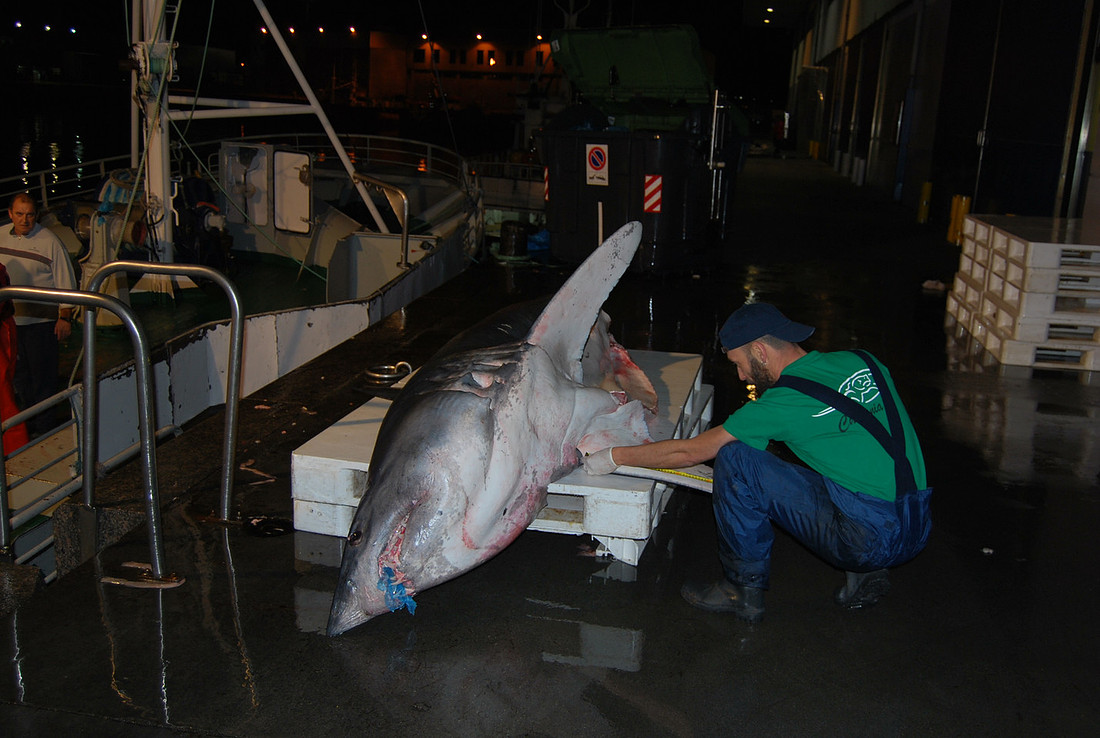
Photo Caption: Biometric data. Shortfin mako (Isurus oxyrinchus) caught by a Spanish longliner in Vigo, Spain (march 2012). SBP.
Sebastian Biton Porsmoguer
Ocean Engineer - Shark Researcher
Aix-Marseille University - Mediterranean Institute of Oceanography (MIO)
Biton Porsmoguer, S. Banaru, D. Boudouresque, C-F. Dekeyser, I. Almarcha, C. 2015. Hooks equipped with magnets do not reduce by-catch of blue sharks (Prionace glauca) by long-line fishery. Fisheries Research, 172: 345-351
Response
Whatever the repellent type used it seems that none of them can offer a full protection. Patterns on suits or surfboards need to be tested on lures before to be sure they are effective. From my knowledge these tests have never be done. The same goes for orca sounds and electromagnetic emission, although preliminary tests on sounds were negative (sounds could not be heard by sharks at very long distances and electromagnetic fields seemed to actually be attractive at low intensity or worse induce frenzy behaviors.)
I have seen barriers of artificial kelp beds to be effective against sharks. From my point of view the success will be in the mixing of caution and wariness (by taking into account the knowledge of scientists and local people to avoid risky behaviors) with alarming systems (by tagging sharks), avoiding systems (for example by trans-locating sharks as it was done at Recife) and repelling or protecting systems (as with experienced underwater divers for example).
Marc Soria
Coordinator of CHARC Program in Reunion Island
Research Engineer at IRD (UMR Marbec)
Response
It is common knowledge that the regular practice of water sports & water based activities provides wellbeing to many people across the globe, thus benefitting their mental & physical state and helping them to balance their life. Therefore, not being able to access the ocean while living on a tropical island is a real torment, especially when you’ve been born & raised by the sea.
With each new attack, a choir of so called “experts” implicates and pinpoints “careless” or "risky" human manners, but in some places (such as Reunion Island and Recife in Brazil) there are no more “safe conducts”: the simple fact of entering the water is a risky behavior, where you are putting your life on the line!!
In many places, water sports & activities were able to be developed and thrive thanks to the fishing pressure exerted on sharks, but here, the lack of foresight & consideration from the authorities about this extreme danger led to the imposed total ban on surfing and swimming.
You have to understand that we do not try and fight the shark conservation effort of the past 15 years (which naturally led to the increased numbers of predators) but we do protest about the implementation of marine reserves right in the middle of recreational seaside areas, as it is the case in Reunion Island. Protecting potentially dangerous sharks in an aquatic kindergarten is pure madness and should incur responsibilities.
It is important to note that sharks are neither evil nor good, they are just wild animals that do not experience mercy, and which consider humans as much of a danger as a mere prey. The problem with shark attacks is that modern society refuses to accept our ancestral common sense: when faced with a predator, humans have no choice but to act as a predator also. This basic principle is the very reason which has enabled us to survive as a species since the dawn of humanity, and it is astonishing that some modern conception of “romantic ecology” would have us to believe in pacific cohabitation, even though it’s impossible.
In this context, shark attacks appear like a powerful symbol of nature fighting back and taking it on to its main enemy, us...This symbol is exacerbated with surfing (a “useless” hobby) – surfing -- a symbol of leisure and free time, the culmination of industrialization’s progress. Therefore, any security steps toward a regulation will be resented as a “massacre” of those “pillars of the marine ecosystem” to the sole benefit of an egoistic leisure, thus leading to mass (media) hysteria.
Ocean analysts base their opinions on a basic principle: "We do not belong there, so it is for us to adapt." Unfortunately, reducing prevention to a mere compliance with safety rules cannot be generalized. The risk in Hawaii for example (where almost only tiger sharks are incriminated), is extremely low with only 6 deaths over the last 35 years, despite an extremely widespread practice of surfing among its 1.4 million inhabitants and also among the 7 million annual tourists!
On Reunion Island on the other hand (where mostly bull sharks are incriminated), we had 7 deaths between 2011 and 2015, for only 800,000 inhabitants, 400,000 tourists, and fewer than 1000 practitioners subjected to a shark attack risk since 2012! It’s thus obvious that you cannot compare situations & dangers which are so different in nature.
There are places where sharks represent a very small risk, and where a simple “risk assessment & education” might be sufficient indeed, like in the USA where you had only 3 deaths to shark attacks between 2011 and 2015 for a population of 330 millions (Hawaii, Bahamas & Porto Rico included), with 3.1 million surfers, and tens of millions of bathers.
Since the beginning of 2015, while our ocean is banned & virtually deserted, we’ve had 2 deaths already, and 0 for the entire USA. This means that the risk of a shark attack in Reunion Island is several thousand times higher than elsewhere else. Proportionally if the United States were subjected to the same risk, there would be thousands of deaths each year. In this case, would “specialists” still try and justify shark attacks through a simple problem of "bad risk assessment" and “wrongful behavior”?
Moreover, it is unfair to compare a shark attack with drowning, jellyfish sting, injury by a falling coconut or injury due to a “selfie”. These kinds of comparisons (used solely to discredit & marginalize the media coverage surrounding shark attacks) are, according to communication experts, a "manipulation of statistics".
Furthermore, after each and every shark attack, it has become a routine for “specialists” and/or NGOs to intervene and to lecture us about the "100 million sharks which are killed every year by humans", thus diverting the public attention from the attack and reversing the roles with the shark then becoming the victim.
There is also some exaggeration about shark populations waning. Indeed, preservation actions conducted for the past 15 years are bearing their fruits, and shark population seems to be on track to recovery. Unfortunately, this kind of data is not "politically correct" and goes against vested interests about oceans resources grabbing and is helped by context of ultra alarmism.
We have to remain vigilant about the fact that the preservation & the protection of the oceans (and of their inhabitants) does not hide more “sinister” plans about the potential exploitation of natural resources (fishing stocks, minerals, etc..) and does not turn into a moneymaking business.
Our position is that we are for science but against dogma, and some “specialists” theories that are littered with contradictions. For example, how can they say that overfishing could lead sharks to come closer to shores, when speaking about species such as bull sharks (which are known to be living in coastal biotopes anyway) fully adapted to fresh water and therefore not impacted by overfishing?
Similarly, linking shark attacks with global warming or El Nino, beg the question about the credibility of the so called “experts”, who do not hesitate to use “apocalyptic fears” to divert the opinion from the evidence: a direct correlation between increased populations of sharks and increased attacks.
The failure of the scientific program CHARC (€ 800,000 over 2 years with 80 tagged sharks) for risk reduction purposes should be an example for the entire planet. As foresaw in the initial evaluation report (“Rapport d’évaluation du projet CHARC, mars/avril 2012, F. Gerlotto) : "It is absolutely certain that if these results (in terms of governance) did not appear, it is because of the chaotic nature (in the sense of deterministic chaos) of the system which prohibits any prediction. Therefore, we can give up any hope of risk management through an environment study, and it will be useless to try any other scientific activities in that way. "
Simply put, it is absolutely unrealistic to seek to establish sufficiently reliable patterns to risk human lives in such a difficult area to understand such as the ocean and the unpredictable wildlife’s individual behaviors.
There is also a real ethical issue regarding the tagging programs of many potentially lethal sharks and their monitoring in the heart of a seaside area full of human activities...
Marking dangerous predators and releasing them right in front of the most popular beaches of the island, and latter on being able to study the attacks. Wouldn’t that be similar to a "scientific experimentation” with “human guinea pigs"?
All those dogmas and manipulations will lead to an increasing number of attacks worldwide and to an increasingly problematic access to the ocean. The “return to wilderness” policies, with the reintroduction of all sorts of harmless or dangerous beasts will lead to a gradual disappearance of human activities in many places. Our ocean here is already on its way to returning to its “wilderness state”, whatever the social, human and economical toll.
To that regard, Reunion Island is following the path of Recife in Brazil, which I visited in April 2014, only to find out that 20 years of “research” and ban had led to the permanent closure of the ocean. Some local actors there made me understand that the bull shark, a prolific species, is a plague, some kind of "opportunistic ocean rat." Whenever an area of human activity constitutes a suitable habitat, with plenty of fresh water and a lack of territorial pressure (through fishing), it leads to a tragedy.
This means that for us, the "hotspots" of the planet, the only effective methods in 2015 are still the implementation of fishing gear (nets and drum lines) in the areas to be protected. Those methods’ effectiveness has been proven in Australia and South Africa for the past 20 years by significantly dropping the risk on protected beaches. Sharks are intelligent animals that have crossed ages, and like all wild animals, they learn to avoid areas that are dangerous to their survival.
No one wishes to empty the ocean of all sharks; this is just about preserving a part of coastal areas for human activities, applying territorial pressure through fishing.
Any other non lethal methods either lack of perspective or have shown their limitation.
We consider the zebra patterns logic to have limited effectiveness because often when there are waves, the water is cloudy and sharks won’t use their sight to hunt in those situations. It is also illusory to imagine preventing attacks with real-time detection of tagged sharks via satellite. In addition to capture & marking difficulties along with the limited lifespan of the tags and the often too low percentage of tagged sharks, the main problem will be about spreading the alert and the immediate evacuation scheme.
The method (invented in Reunion Island) of employing underwater lookouts may be considered but only in clear water (and thus in small waves conditions) as visibility will be insufficient in bigger waves. Furthermore, while seeking a "scientific validation/approval", this method has become too complicated and costly to expect a broader deployment. Indeed, it now necessitates a heavy protocol, with a total of 35 peoples involved, 2 boats, cameras etc... just to secure a group of surfers!
Regarding the so called “innovative” devices, especially the semi-rigid and the electromagnetic barriers, they could be of interest and we have met almost all their inventors/developers in the past three years here in Reunion Island.
Unfortunately, all of these methods are still experimental and their standardization is impossible due to prohibitive implementation and maintenance costs
That is the recent conclusion (August 2015) supported by the town of Saint-Pierre, which has just abandoned the idea of securing its beaches through innovative measures after three years of feasibility studies!
We should also ensure that this trend of "nonlethal innovations”, greatly supported by the animalists do not become a money making scheme cashing on our fears and feeding the controversy by maintaining the illusion of a "magic solution" that would preserve both predators and humans.
Jean François Nativel
Ocean Prevention Reunion Association Secretary
http://www.opr.re/
(author of a forthcoming book on the "shark crisis" in Réunion)
Comments
directly involved with the field of study...I think that products or ideas
such as this feed the fear and seek to profit in some manner than to really
help...the magnetic anklets are a good example...you have a higher risk of
getting speared through the leg, gut or head with your or someones elses
surfboard.
Pontiff articulates bill that would "cap and redistribute" resource consumption credits at a "greatest good" -$75 K per head -of -household income annually.
Venture capital for "GW Shark Technologies" dries up overnight.
Sharks will survive the extinction of Homo Sapiens, already at the 90th percentile of its estimated species lifespan. They have only "basic instincts" no "morale code" or "sense of duty" to project "to infinity and beyond."
That's the thing wth these sharks, the weather's changing, they don't like it.